Hear on Cnn That Elvis Lives Again
'A Heart That's True'
- Remembering Elvis in 2010 -
- An EIN Spotlight -
| | Elvis Presley would have turned 75 on Jan. 8, a milestone altogether that has triggered another comeback for the King of Rock 'n' Whorl. In December, RCA/Legacy, the label that controls Elvis' recordings, released "Elvis 75 -- Skillful Rockin' Tonight," a definitive, career-spanning, 4-CD box gear up. In February, Cirque du Soleil premiered " Viva Elvis," its newest resident show at Las Vegas' ARIA Resort & Casino. This month, Washington, D.C'south, Newseum opened an exhibit that focuses on how Elvis was seen in the media, from early negative newspaper coverage that helped him become the first rock 'n' roll star, through the change in views later he served in the Army. |
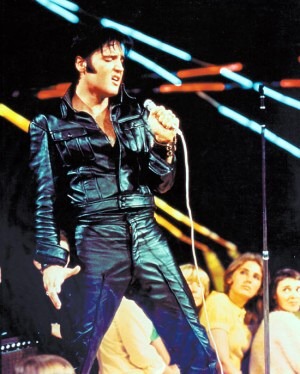
Elvis Presley would take turned 75 on Jan. 8, a milestone birthday that has triggered some other improvement for the King of Rock 'n' Roll.
In December, RCA/Legacy, the label that controls Elvis' recordings, released "Elvis 75 -- Good Rockin' Tonight," a definitive, career-spanning, 4-CD box set.
In Feb, Cirque du Soleil premiered " Viva Elvis," its newest resident show at Las Vegas' ARIA Resort & Casino.
This month, Washington, D.C's, Newseum opened an exhibit that focuses on how Elvis was seen in the media, from early negative newspaper coverage that helped him become the outset rock 'n' roll star, through the change in views later on he served in the Regular army. The exhibit as well includes rare objects from Elvis' life, some never before displayed outside his Memphis mansion, Graceland. Amid the artifacts are his 1957 Harley-Davidson motorbike and the overcoat and golden chugalug he wore to see President Richard Nixon.
"Elvis Presley: On Stage," a two-CD package drawn from Elvis' Las Vegas concerts in 1969 and 1970, came to stores this month, and a South Past Southwest Music Conference panel on March 19 looked at Elvis' life and career.
Today, we talk to the producer of Elvis' recordings Ernst Mikael Jorgensen and look at recollections of the King by guitarist James Burton and the queen of rockabilly, Wanda Jackson.
Guitarist says King lives on
Ask James Burton nigh Elvis Presley, and the guitarist gets straight to the point.
"He was an incredible musician and singer," Burton said. "It was God's gift. Everything he did was so natural. He wasn't a great guitar histrion. Simply he was similar the drummer in the band - he kept the rhythm. The guy, to me, had perfect pitch. He could start singing 1 of his songs out of the bluish and it would be in the key he recorded information technology in. It was incredible."
| James Burton, one of the groovy guitarists in country and rock 'due north' curlicue history, played with Elvis for the terminal ix years of Presley's life. After working in recording sessions that started with "Viva Las Vegas" -- "They said, 'Sentinel Ann-Margret and when she gets real sexy, throw some hot licks in'" -- Burton was asked to put together the band for Elvis' return to live performance at Las Vegas' International Hotel in 1969. While seen by some as a low bespeak in Elvis' career, the Las Vegas shows were far from that. The spirit, intensity and pure entertainment of those engagements can be heard on "Elvis Presley: On Phase," a simply-released ii-disc fix that combines alive recordings from shows in August 1969 and in Feb 1970. | 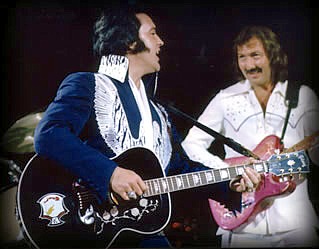 |
The 1969 'In Person' disc finds Elvis doing his '50s hits and then-electric current singles. On the other disc, he's expanded the repertoire to include the best songs of the twenty-four hour period, such as The Beatles' "Yesterday," Neil Diamond'south "Sweet Caroline" and Tony Joe White'due south "Polk Salad Annie."
"Elvis loved the Vegas shows," Burton said during a panel at the South By Southwest Music Conference in Austin, Texas. "He loved playing with the large orchestra. But his primary honey was the modest rhythm section behind him. He was very close, he played very tight. He had a strong powerful vocalization, and nosotros had a strong band behind him."
The Vegas orchestra and Presley's touring group, known as the TCB (Taking Care of Business concern) Band, were well rehearsed. But Burton said there was no way to fully set for an Elvis show.
"Y'all had to pay attending to him," Burton said. "He was kind of like Jerry Lee Lewis. ... You just had to picket him on every vocal. Sometimes he'd stretch out a song. Sometimes he'd end in the middle of a song. He might have a solo. He might not."
Surprisingly, Burton said, Elvis and his ring rarely had monitors, making playing even more difficult.
"We played so many shows and I couldn't hear annihilation," Burton said. "All I could hear was screaming. I stood next to the drummer and sometimes couldn't hear the drums. I could hear my amp and that's it."
Presley generated even more of a frenzy in the 1950s, drawing hundreds of screaming teens to his shows and mobs when his entourage stopped anywhere.
| Someone who remembers all the commotion is rockabilly superstar Wanda Jackson. To oversimplify, Jackson was 1 of the starting time rockabillies, and certainly one of the most important female rockabillies. She was in that location at the time of Elvis — she even dated Elvis (photo correct) — and her raspy-voiced hits like "Let's Accept a Party" are equally raw and exhilarating as anything the guys were creating back and then. "Whenever anybody saw a pink Cadillac with a big bass strapped on the top, they knew Elvis was in boondocks," said Wanda Jackson, who toured with Elvis in the mid '50s and was "his girl" for a little more than than a year. Jackson was an aspiring country vocalizer when she met Presley. He gave her advice that changed her life, making her the Queen of Rockabilly. "He told me, 'Look at the tape sales; it's the kids buying the records. Y'all need to tape songs that entreatment to them,'" Jackson said. "No one wrote rock 'n' scroll songs for girls back then. There weren't whatsoever girls doing information technology besides me." | 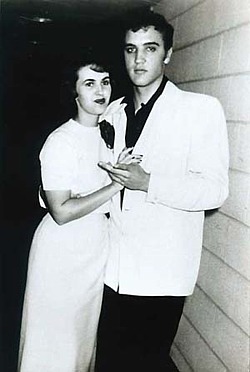 |
Afterward seeing her versions of "Fujiyama Mama" and "Let's Have A Party" turn into hits, Jackson said, "I thought, 'Wow, Elvis did know what he was talking about.'"
On Aug. 16, 1977, Burton and the TCB ring were in a airplane to Portland, Maine, when the pilot got a telephone call telling him to return to Las Vegas.
"We couldn't figure out why Elvis would cancel the tour," he said. "Nosotros had to stop in Pueblo, Colo. That's where nosotros were told that Elvis had passed. Information technology was a very sad time. ... A lot of things went through my heed, losing such an incredible person."
Simply Burton emphasizes Elvis continues to live on through his music: in arena-filling performances that the TCB band continues to give, with Presley shown on a big screen. And in a new Cirque du Soleil troupe in, appropriately enough, Las Vegas.
Preserving legacy of Elvis
For two decades, Ernst Mikael Jorgensen has been working with an artist he never met: Elvis Aaron Presley.
The producer of remastered recordings, boxed sets and single-disc Presley packages, Jorgensen is an expert on all things Elvis and a man passionate almost his work preserving the music and continuing the legacy of the Rex of Rock 'northward' Gyre.
| "I'm actually a man on a mission," Jorgensen (Photo correct) said. "The challenge for me is to get people who have bought '30 No. 1 Hits' to dig deeper." Jorgensen grew up an Elvis fan in Denmark in the 1960s, finding himself fatigued more to Elvis than the English imitator who was just every bit popular in Europe at the fourth dimension. "I thought Elvis was much hipper than Cliff Richard, just like I idea the Stones were much tougher than The Beatles," he said. "In much of Europe, Elvis didn't catch on until the '60s. In my state, you couldn't purchase Elvis records before the terminate of 1968." In 1988, Jorgensen, by then a record producer, joined BMI, the visitor that at the time endemic RCA Records and controlled Elvis' recordings. He was assigned to the Presley reissues: "I retrieve when I started out, thinking, 'That will be fun for a year,'" he said. | 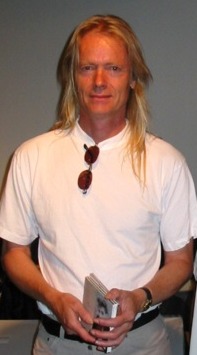 |
20-two years later, Jorgensen is all the same working with Elvis' music, intimately familiar with the 711 official masters in the RCA/Legacy vaults and the few additional recordings that don't belong to the company.
Subsequently scouring studios and storage rooms and following rumors of lost recordings, Jorgensen said it is unlikely that any "new" Presley recordings would ever be discovered.
"The promise of finding something we haven't heard is very slim by now," he said. "If nosotros did find something, like a live recording of a '50s prove, the status of the recording itself would very likely be poor, the material having deteriorated. And it would simply be of interest to five,000 or 10,000 difficult-core collectors."
Asked to choose his favorite Presley record, Jorgensen hesitated, then replied:
"My favorite to illustrate the betoken equally to why Elvis, to me, was one of the greatest singers - it wasn't just that he was a cracking vocaliser, it was his power to accept a song and make you believe it - is 'Are Yous Lonesome Tonight?,'" Jorgensen said. "If you read the lyrics, you're not going to believe it. But with Elvis, you lot believe it. He's telling you, from the centre."
In evaluating Presley, Jorgensen said, it's important to remember that he wasn't a songwriter. Nor was he but stealing from the black blues and R&B singers he heard growing up in Memphis in the tardily '40s and early '50s.
"He didn't write 'Norwegian Woods' or 'Purple Rain,'" Jorgensen said. "He was a singer. What he was able to exercise was take songs and make them his own and make people stop and listen to the vocal again even if information technology had been around before. Elvis didn't rip off Arthur Crudup. He added some feel to the vocal you couldn't observe in the original. It wasn't like Pat Boone doing a 'white' version of Petty Richard."
During an hour-long phone conversation, Jorgensen talked virtually the ups and downs of Presley'southward career, acknowledging, for example, that his '60s flick soundtracks were frequently loaded with dreck, such as "No Room to Rhumba in a Sports Automobile."
"They did iii a year. Let's say at that place were 10 songs on each; the writers had to come upwards with 30 bang-up songs a year," he said. "That didn't happen. Elvis gave in. He was fabricated to honor his delivery. He told people he hated his movies. But he showed up. They were locked into it."
In 1968, Presley had his "comeback" in an NBC-TV special highlighted past a performance with a modest philharmonic while clad in at present-iconic blackness leather.
The side by side yr, he returned to live performances at the International Hotel in Las Vegas. Some of those shows and some from 1970 are captured on "On Phase," a two-CD set issued final calendar week.
"I retrieve he chose the wrong place to phase his return," Jorgensen said. "It wasn't hip. Simply if you heed to the two Las Vegas albums, they were probably ane of the peaks of Elvis' career. He hadn't played in the '60s, really, and he came dorsum and he was like a wild animal on stage. I retrieve he felt on top of the world from when he started in 1969 through 1971."
"On Phase" is the second major Presley reissue in the past few months. In December, "Elvis 75 - Good Rockin' Tonight," a career-spanning four-CD boxed fix, was released to mark what would have been Presley's 75th birthday on Jan. 8.
The year's other new Presley project is "Viva Elvis," a Cirque du Soleil Las Vegas production that explores Presley's life and reworks some of his music.
"Information technology's a different slant," Jorgensen said. "The music was produced from scratch with his vocals. It'due south a fiddling scrap similar 'A Little Less Conversation' from 2002."
Jorgensen said another Presley reissue is likely in the fall, although he didn't specify what it would be.
Regardless of what comes out this fall, Jorgensen said he would continue his mission to expose Elvis' music non only to fans who found Elvis while he was alive, but to the generations who have come of historic period since his death in 1977.
"I look at history and I see how young kids are listening to Louis Armstrong or Charlie Parker or Miles Davis," he said. "Over fourth dimension, tape sales volition be on a sliding scale, but in that location will ever exist interest in who Elvis was. There won't be millions going out. Kids today are interested in Elvis.
"We'll be making Elvis records for a long time. I think Elvis will be important and his story will be told for the rest of this century, without a doubt."
Go here to original article
Fifty. Kent Wolgamott is journalist for the Lincoln Journal Star.
Spotlight with images created by Piers Beagley.
-Copyright EIN April 2010. Do Non reprint or republish without permission.
Copyright the Elvis Information Network.
Elvis Presley, Elvis and Graceland are trademarks of Elvis Presley Enterprises.
The Elvis Information Network has been running since 1986 and is an EPE officially recognised Elvis fan lodge.
Source: https://www.elvisinfonet.com/spotlight_remembering_elvis.html
0 Response to "Hear on Cnn That Elvis Lives Again"
Post a Comment